News
Events and offers of Derenivska Kupela for a bright and unforgettable vacation


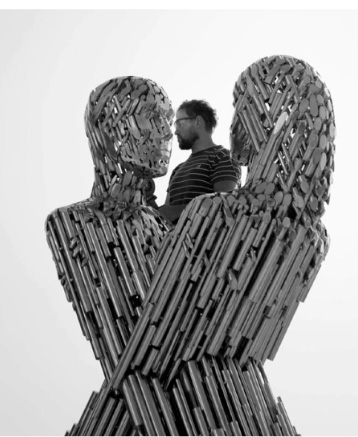
He was born in Dnipro into the family of a sculptor, which largely determined his professional path.
2003 — graduated from the Taras Shevchenko State Art Secondary School.
2009 - graduated from the National Academy of Fine Arts and Architecture with a degree in sculpture.
2012 — completed his assistantship-internship at NAOMA.
Later, he was engaged in teaching activities, in particular, he taught drawing and sculpture at the I. K. Karpenko-Kary Kyiv National University of Arts and Crafts.
Yegor Zigura's professional path began early: as a teenager, he worked with his father, completing orders that combined craft and creativity.
After graduating from the academy, he chose the path of an independent artist.
Zigura is the author of numerous public sculptures installed in Ukraine, France, Australia and the USA. His works regularly participate in international exhibitions, art fairs and sculpture parks, shaping the presence of Ukrainian sculpture in a global context. His practice encompasses both easel and monumental sculpture, as well as installations and art objects.
Since 2012, he has been a member of the National Union of Artists of Ukraine.
The artist's works have been presented on leading international platforms, including Phillips and Sotheby's auctions, as well as at art fairs and exhibitions in Europe, the USA, Asia, and Australia.
Among them: Spectrum Miami, Volta Basel, Tokyo International Art Fair, Sculpture by the Sea (Australia), Niwot Sculpture Park (USA) and others.
Sculpture "Unity" (Dniprovska embankment, Kyiv)
Sculpture "Atlant" (Dnipro)
Installation "R/Evolution" (Dnipro)
Sculpture "Be brave" (Kyiv)
His works often exist in dialogue with space, emphasizing the interaction of man, environment, and time.
Yegor Zigura works at the intersection of classical plastic tradition and contemporary art. His works clearly trace an appeal to ancient heritage, while these images are transformed, acquiring new meanings in the context of the present. The sculptor explores the themes of identity, globalization, consumerism, environmental threats and the fragility of civilization. Zigura combines traditional materials: bronze, stone with modern materials and polymer structures. An important component of his practice is the balance between form and idea. The sculptor insists on their inseparability: plastic does not illustrate the concept, but exists with it as a single whole.

Petro Antip was born in 1959 in the city of Horlivka in the Donetsk region — in the very heart of the steppe Ukraine. In 1980–1984 he studied at the sculpture department of the Penza Art School named after K.A. Savitsky. Then he studied in the private studios of V. Tsoi and O. Bem (1982–1986).
His works were purchased by the Ministry of Culture of Ukraine and are included in the collections of museums and galleries in France, Germany, Italy, and Sweden.
Petro Antip is the author and co-author of dozens of large-scale projects and monuments:
Monuments:
Antipas' style is a philosophical poetry of form, where metal, color, and word become markers of historical memory. It is an epic of the steppe, filled with archaism and metaphors. His works are not just sculptures or paintings, but visual parables that ask the eternal questions: "Who are we?" and "Where are we going?"
Antip does not imitate the archaic — he rereads it, sometimes in a rigid, almost expressionistic form. His sculptures are usually vertical, massive, reminiscent of Scythian women, ancestral pillars, cult totems. In his painting, the forms are simplified, almost iconic.

Born in 1960 in the village of Chornotychi, Chernihiv region.
He graduated from the Uzhhorod School of Decorative and Applied Arts (1979) and the Sculpture Department of the Kyiv State Art Institute (1986), where he studied in the workshop of Mykhailo Vronsky. Already on his diploma, his sculpture "Motherhood" was acquired by the National Art Museum of Ukraine.
Since the 1980s, he has participated in state-level exhibitions, and since the 1990s, in author's and international projects. Member of the National Union of Artists of Ukraine.
He works in sculpture, graphics, painting, and installation. The artist's works are kept in the Chocolate House Art Center, the National Museum "Kyiv Art Gallery", the National Art Museum of Ukraine, the National Reserve "Sophia of Kyiv" in Kyiv, and many other museums in Ukraine and abroad.
Oleksandr Sukholit is one of the few artists who has integrated sculpture, painting, and graphics into a single visual language. The artist has preserved in his work a connection with the land, nature, and traditional Ukrainian sensuality, combining it with European cultural heritage.
Alexander Sukholit's style was formed outside of temporary trends, and the imagery of his works is rooted in universal symbols, most often a female figure. In his sculptures, it is easy to recognize metaphors of waiting, prayer, and sorrow. The human figure here is not an individual portrait, but a carrier of universal human experience, through which the artist speaks about the main thing: about love, pain, presence, and memory.
Sukholit consciously avoids naturalism, not working with nature in the literal sense. For him, the body is not only a physical object, but above all a container for the spirit. His sculptures do not demonstrate muscles or anatomy, they capture a state - a state of concentration, search and silence.
Graphics occupy a special place in the artist's work. His drawings are made in ink, charcoal, and sometimes watercolors. They are simple in means, but profound in meaning. Often this
figures of women reduced to a sign, a line, a gesture. In these works there is meditation, intuition, a relaxed movement of the hand, which captures not the external, but the internal. Graphics for Sukholit is not an auxiliary tool, but a separate world in which he continues the same dialogue as in sculpture.
Despite recognition, exhibitions, and presence in museum collections, Sukholit does not seek publicity; one thing is important to him: honesty before form. His work is not a career, but a path. And this path is deeply spiritual.

Born in 1956 in Kyiv. Graduated from the Lviv Institute of Decorative and Applied Arts in 1979 with a degree in design. His mentor was the prominent sculptor Emmanuel Mysko.
He has been participating in exhibitions since 1980, and has been a member of the National Union of Artists of Ukraine since 1987. He works in Kyiv and actively exhibits in Ukraine and abroad. Dyachenko's works are included in the permanent exhibitions of 5 art museums in Ukraine.
Oleksandr Dyachenko is a sculptor for whom art is not a reaction to the present, but a deep, lasting message in time. He does not accept negativity in sculpture, for him this
the art form has a different nature.
“Painting or graphics can scream, protest, criticize, but sculpture is silent, tactile, almost sacred. It needs to be touched – and therefore it must be a source of strength, not anxiety.”
He is attracted to man not as a portrait or an object, but as a part of nature. He is interested in how harmonious and organic this part is – both externally and internally. In all his works there is a respect for the human essence: for dignity and inner light.
Dyachenko says: “Art is the energy of the individual.” His sculptures truly convey inner energy, they pay attention to form, rhythm, and balance. He does not work with “current” art, because sculpture, according to him, takes too long to make and lasts too long. Its mission is not to be a reaction, but a foundation. In Alexander’s sculptures, echoes of archaic plastic art can be traced: Cimmerian, Scythian,
antique. Its forms are concise, balanced, devoid of ornamentation. They encourage concentrated, almost meditative contemplation.

Mykola Bilyk was born in 1953 in the village of Toporivtsi.
in Bukovina.
In 1972, Mykola Bilyk graduated
Vyzhnytskyi School of Applied Arts.
In 1980 he graduated from the Lviv Institute of Applied and
decorative art.
He began his creative path in the 1980s in the production association "Artist". He was admitted to the National Union of Artists of Ukraine in 1986. Since 1981 he has been actively participating in republican, all-Union and international exhibitions in Ukraine, Germany, France and the USA. The sculptor's personal exhibitions were held in Kyiv and Munich. Since 1994 he has been a professor at the Department of Sculpture of the Kyiv State Academy of Decorative and Applied Arts named after Mykhailo Boychuk.
Mykola Bilyk's works are the visual language of Ukrainian identity. At the center of Bilyk's work are people, nations, memory, as well as a deeply meaningful image of women, family, people, and nature as the foundations of existence. Mykola Bilyk is easily recognizable by his exquisite plastic language, harmony of form, and deep meaning. His works encourage not just to look, but to feel and remember.
Mykola Bilyk is a witness and creator of the era, whose works are kept in Ukrainian museums and private collections in France, the USA, Canada, Belgium, and Germany.

Born in 1952 in the village of Jablonec nad Nisou (Czech Republic). In 1972 he graduated from the Uzhhorod School of Applied Arts, and in 1978 from the Lviv State Institute of Applied and Decorative Arts.
Member of the National Union of Artists of Ukraine since 1985. Works in the genres of monumental sculpture, small plastic art, medal art and park sculpture. Author of over two thousand works created in bronze, stone, and clay.
Participant in art exhibitions since 1976, art symposia since 1985.
Held over 16 personal exhibitions in Ukraine and abroad — in particular in Uzhhorod, Kyiv, Prešov, Budapest, and Medzhylabyrtsy.
Bohdan Korzh's works are mostly symbolic sculptures, filled with metaphors. The artist believes that sculpture should be understandable to any person, regardless of culture and nationality.
I am a sculptor. Period. These words are not just self-definition. They are the essence of Bohdan Korzh's creative philosophy: deep, holistic, honest, with a sense of form, material, and most importantly, freedom.

Born in 1951 in the village of Velyka Turya, Ivano-Frankivsk region. Graduated from the Lviv State Institute of Applied and Decorative Arts in 1979.
Vasyl Yarych's style is a combination of monumentality with philosophical depth and restrained emotionality. His sculptures avoid excessive dynamics, sharp contrasts and unnecessary details. His work includes both strict stone monuments and elegant wooden female torsos. The sculptures are created from scratch: from a sketch to a finished bronze form - without digital technologies.

Born in 1960 in the village of Sadzhava, Ivano-Frankivsk region.
He studied at the Kosiv Technical School of Folk Arts named after V. Kasiyan, majoring in woodcarving. 1984–1989 — he earned the profession of a monumental sculptor at the Leningrad Higher Art and Industrial College named after V.I. Mukhina.
Vasyl Tatarsky is a Ukrainian avant-garde sculptor who works at the intersection of industrialism, constructivism, and non-figurative sculpture. His sculptures are not a description of reality, but an interpretation of feelings and thoughts. He does not get attached to the subject matter - instead, he seeks a plastic solution that corresponds to an inner impulse. The work of Kazimir Malevich had a significant influence on the artist's worldview. In particular, the idea of the "Black Square" became an impetus for deep personal interpretations.

Born in 1975 in Uzhhorod. He received his primary art education at the Uzhhorod School of Applied Arts named after A. Erdel (1991–1996).
He continued his studies at the National Academy of Fine Arts and Architecture, where he later became an assistant professor, and since 2016, an associate professor.
Since 2019, he has headed the Department of Sculpture at NAOMA, which testifies not only to the recognition of his professional authority, but also to his influence on the formation of a new generation of Ukrainian sculptors.
Balog works primarily with natural stone: granite, marble - in a portrait and expressive manner. His sculpture is a philosophical narrative embodied in stone as a carrier of memory, time, and permanence.

Born in 1968 in Fastiv, Kyiv region, in the family of artist Mykhailo Karunsky. Since childhood, she was immersed in an atmosphere of creativity: there were always books about art in the house, which formed her first aesthetic impressions. She drew from an early age, but she got into sculpture by accident. At first, this choice was not conscious, but over time, this hobby turned into a real calling.
1986–1992 — studied at the Kyiv State Art Institute, Faculty of Sculpture, workshop of Professor Vasyl Boroday (a sculptor who immortalized his name in one of the largest monuments in Europe – “Motherland”).
1995–1999 — postgraduate studies at the Ukrainian Academy of Arts.
Since 1987, she has been a regular participant in art exhibitions.
Since 1992, he has been a member of the National Union of Artists of Ukraine.
Her works have been exhibited in numerous exhibition spaces in Ukraine and abroad: in Kyiv, Lviv, Baden (Switzerland), Zurich, Vigo (Spain), as well as in Germany, the Czech Republic, Austria, the USA, and Mexico.
The artist creates chamber and monumental bronze compositions, and also experiments with new materials: papier-mâché, cardboard, mosaic, which expands the expressive possibilities of her plastic art. She pays special attention to the synthesis of sculpture with architectural and urban space.
Participant of numerous group and solo exhibitions, including:
Her works have been repeatedly exhibited at international art fairs in Zurich and Spain. Some of them are kept in private collections in Ukraine, Switzerland, the Czech Republic, Austria, the USA, Mexico and Germany.
Svitlana Karunska is one of those artists who can do everything on her own. She is convinced that only someone who masters all stages of the craft can afford freedom in creativity.
"My father said: be able to do everything so that there is a chance to refuse it," says the artist.
Her self-discipline is combined with attentiveness to the world. She learns from people and situations, constantly observing how life suggests form. For her, creativity is a continuous dialogue between work and thought.
“The robots educate me, and I educate them,” Svitlana notes.
An important feature of the author's position is categoricality. Karunska rejects works that lack inner strength. Such self-demandingness becomes the principle of her artistic ethics.
In her sculptures, there is a desire for purity and clarity of form, for its constructive understanding. The artist consciously simplifies plasticity: in this structural concentration, a special inner energy of the image is born. Natural sincerity is just one of the many manifestations of the character of Svetlana's sculptural images. Her characters are sensitive, full of tenderness and a certain irony.
Her work reflects the intonations of the European plastic tradition, in particular the Italian masters of the 20th century. She is close to the laconicism of Arturo Martini, the simplicity of form and the inner irony of Marcello Mascherini. These features do not turn into imitation, but rather organically transform into a component of her personal aesthetics.
For Karunska, sculpture is poetry in solid material, a metaphor expressed through form. She believes that every detail, every stroke carries the energy of the artist. It is this energy that determines the value of the work.

Mykola Biryuchinsky was born in 1971 in Horlivka, Donetsk Oblast. In 1995, he graduated from the Yenakiyiv Commercial Technical School with a degree in “decorator-artist”.
Since 1998, Biryuchinsky has worked in the studio of the famous sculptor Petro Antip, a representative of the so-called “Gorliv school.” It was there that his style was formed:
structural, with a deep connection to space and landscape.
Mykola Biryuchinsky's works are a synthesis of archaic, symbolism and personal metaphysics. His sculptures are images that embody the path as a philosophical category: life, choice, fate, prayer. He gravitates towards generalized forms: chopped, reduced, but permeated with internal rhythm.
In 2014, due to the war in Donbas, Biryuchynsky was forced to leave his native Horlivka. This period became a profound turning point: the experience of being imprisoned by militants, losing his home, and moving to Kyiv all impacted his creative process and gave it new depth.
The theme of travel is one of the key ones: not as movement in space, but as a path to oneself, to the center. His “Odysseys”, “Milky Ways”, “Prayers”, “Hercules” and “Philosophers” are not about events, but about states, not about plot, but about symbol.
The theme of the "path" for him is not only plot-related, but also metaphysical: the path as a vertical, as a test, as a movement towards meaning. He often turns to biblical symbolism, the figures of Odysseus, Jason, Jonah, but interprets them through the prism of his own experience.

Born in 1962 in Lviv. In 1981, he entered the Lviv Institute of Applied and Decorative Arts (now the Lviv National Academy of Arts), where he studied at the Department of Ceramics. He completed his studies in 1985. His mentors were recognized masters: Dmytro Krvavych and Mykola Posikira.
In 1989 he became a member of the National Union of Artists of Ukraine. His works were exhibited in prestigious institutions:
Oleh Kapustyak is an artist of postmodern thinking, his sculpture does not copy reality, but reveals its essence. His plastic appeals to classical form, but is devoid of academic beauty in its traditional sense. In addition to creativity, Kapustyak is actively engaged in restoration. He participated in the restoration of Pinzel's sculptures at St. George's Cathedral in Lviv, in the restoration of tombstones at the Lychakiv Cemetery - a sacred place for Ukrainian cultural memory. He also teaches and shares
experience with a new generation of artists.

Born in 1943 in the village of Vovkovii, Rivne region.
He studied at the Ivan Trush Lviv School of Applied Arts, and later at the Lviv State Institute of Applied and Decorative Arts, where he focused on artistic metal.
Oleg Bonkovsky is a representative of the "new blacksmithing", reviving the artistic tradition of metalworking. His style combines folklore motifs, sacredness and modernism: poetic crosses, fragmentary gates, artistic weaving of plastic. For him, metal is a carrier of folk symbolism, history, national memory and spirituality.
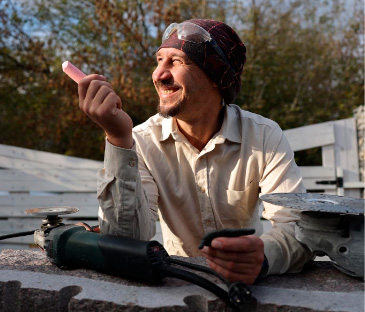
Mykola Novikov was born in 1980 in the mining town of Novogrodivka, Donetsk region.
His creative activity includes participation in the All-Ukrainian Sculpture Triennials (2008, 2011, 2014, 2020), thematic exhibitions for Artist's Day, as well as personal and collective projects.
Among them:
Mykola Novikov's sculptures are constructed in such a way that the form leads the gaze, creating rhythm and internal tension. Working with fireclay, stone and bronze, the artist conducts a dialogue with the material, carefully listening to "how the material leads and dictates its rules". Stone sets boundaries, bronze allows for refinement and development of plasticity. The key is the "transition line" - the moment where the static begins to "breathe", and the form acquires internal movement. In this process, the artist's main theme is revealed: the interaction of man, matter and internal state.

Born in the village of Kadobna, Ivano-Frankivsk region.
The craft was passed down to him as an inheritance - his grandfather had his own
a forge, where, according to the family, there was a UPA hideout.
Before the full-scale invasion of Russia, Ivan Bodnar had been engaged in decorative metalworking for over 14 years. His forging is distinguished by precision, aesthetics, and manual perfection. He creates artistic elements that bring an ancient craft to life in a modern context. Since the beginning of the Great War, Ivan has expanded the scope of his work. His forge has become a place where not only artistic products are forged, but also parts for Ukrainian defenders.
Ivan Bodnar's biography intertwines several layers: tradition, struggle, art, and the spirit of resistance. His craftsmanship is not just an example of Ukrainian craftsmanship, but a gesture of solidarity and action that supports not only physically, but also morally.

Martin Navratil is a multifaceted and talented artist from Slovakia, who is mostly known for his sculptures. Martin graduated from the Academy of Fine Arts and Design in Bratislava. During his studies, he completed an internship at the Academy of Fine Arts in Prague in the studio of figurative sculpture under the guidance of Professor Jan Hendrich.
The main vector of creativity is the search for new forms of expression through the synthesis of traditional sculptural skills and innovative techniques. Influences of such artistic trends as avant-garde and modernism help him move away from the static nature of form, giving his works dynamism, emotional depth, and symbolism.

Pavel Zouhar (born 1974, Rudice, Czech Republic) is a contemporary Czech sculptor who transforms cast iron into elegant sculptures. His art is a continuation of an ancient family and local tradition that he began cultivating as a child, casting figures from plaster and lead.
In 1992, he acquired the profession of a foundryman, and later, relying on his deep knowledge of metallurgy, he turned to art. Since 2005, the artist has devoted himself entirely to artistic casting, using his deep understanding of metal and developing his own techniques.
Zoughar focused on figurative sculpture, especially female figures. His style is elegant yet powerful. The master admits that his work was influenced by artists such as Alberto Giacometti and Olbram Zouger, sculptors who worked with minimalist and elongated silhouettes.
He performs all stages: from modeling, shaping, casting to final polishing and patination – independently. For him, sculpture is a necessity of life, not just a hobby or profession. Cast iron is a complex, heavy, but noble material. “It is a metal with character – ideal for art,” says the master.

Born in 1981 in Uzhhorod in the famous creative family of poetess Lydia Povkh and artist Petro Khodanych.
1996-2002 — studied at the Uzhhorod College of Arts named after A. Erdel.
2002-2004 — studied at the Lviv National Academy of Arts.
He works in the genre of small modern and decorative landscape sculpture, easel graphics. Together with his father, he creates carved iconostases, thrones, and tetrapots for temples.
On February 25, 2022, he volunteered to join the Armed Forces of Ukraine, currently a junior sergeant, defends the state on various fronts, and in his free time from combat missions, he continues to engage in creativity.
Mykhailo Khodanych explores the theme of man, celebrating the plasticity of the human body in graphics and sculpture. He has gone from classical knowledge of Transcarpathian carving to his own figurative solution of plasticity. His works combine modern dynamics, folklore motifs and experimentation with material. Mykhailo conveys inner movement and emotional state through a simplified but expressive form. In the public space of the city, he strives for a harmonious combination of art and the everyday life of citizens. Both the surrounding world and urban landscapes become a source of inspiration.

Yuriy Boyko was born on August 21, 1998 in the city of Kalushi. His first attempts at modeling at school quickly turned into a passion, which determined his future path.
In 2014–2020, he studied at the Lviv College of Decorative and Applied Arts named after I. Trush, at the Department of Sculpture. It was his studies that became a turning point for him, where his childhood interest grew into a professional passion.
In 2020-2021, he completed his master's degree at the Lviv National Academy of Arts.
Career and creative path
2020 — laboratory assistant in the modeling department at the I. Trush College.
Yuriy has been a sculpture and modeling teacher at the same college since 2022. For him, teaching is not only a transfer of technical skills, but also a way to more deeply understand his own practice and constantly immerse himself in the subject.
In 2022–2023, he participated in two wood symposiums in the Kozatska Sloboda Rakovets space, where he gained experience working with large sizes and discovered new possibilities of the material.
Exhibition activities
2024 - participation in the international exhibition "Autumn Salon".
2025 — exhibition of a series of portraits at PARK3020. Participation in the PARK3020 Heritage Culture Forum 2025 project.
2025 — participation in the exhibition "Heaven-Hell" (ZAG gallery).
Art style and themes
In Yuriy's work, one of the central themes is the dialogue between material and form. He emphasizes that it is the material that dictates the form. Boyko works with different media and explores their synthesis, not prioritizing one. For him, the feeling of substance, its resistance and plastic potential are more important.
Among the significant influences on his formation, the artist mentions working with Petro Antip, during which he discovered the language of geometrized elements. His teacher Lubomyr Yaremchuk also played an important role, helping him understand plastic art as a living, structural language.
The artist finds inspiration in nature, fashion as a point of intersection of various artistic practices, as well as in archaic symbols, which are actively manifested in his plastic language. Many of his sculptures are characterized by deformations and shifted proportions - means through which the artist works with psychological expression and enhances the structural expressiveness of the image.
An important component of the creative process is sketching — a daily practice that allows you to keep your mind in constant motion and capture the impulses of your search. Currently, Yuriy Boyko continues to develop his own plastic language and is actively working on new series of works.

Andriy Bolyukh is a Lviv artist-blacksmith, jeweler, author of kinetic mini-sculptures, a well-known experimenter in the field of modern metal-plastic art. One of those Ukrainian artists who successfully combines an ancient craft with a conceptual approach to form and image. His work is often called “intellectual blacksmithing” because each work contains an image, an idea, a visual metaphor. A common feature of Andriy Bolyukh’s works, as the author notes, “is the stylistics of “anti-glamour”.
Participant of numerous exhibitions of blacksmithing and jewelry art, including: