Birth and education
Born in 1968 in Fastiv, Kyiv region, in the family of artist Mykhailo Karunsky. Since childhood, she was immersed in an atmosphere of creativity: there were always books about art in the house, which formed her first aesthetic impressions. She drew from an early age, but she got into sculpture by accident. At first, this choice was not conscious, but over time, this hobby turned into a real calling.
1986–1992 — studied at the Kyiv State Art Institute, Faculty of Sculpture, workshop of Professor Vasyl Boroday (a sculptor who immortalized his name in one of the largest monuments in Europe – “Motherland”).
1995–1999 — postgraduate studies at the Ukrainian Academy of Arts.
Career and creative path
Since 1987, she has been a regular participant in art exhibitions.
Since 1992, he has been a member of the National Union of Artists of Ukraine.
Her works have been exhibited in numerous exhibition spaces in Ukraine and abroad: in Kyiv, Lviv, Baden (Switzerland), Zurich, Vigo (Spain), as well as in Germany, the Czech Republic, Austria, the USA, and Mexico.
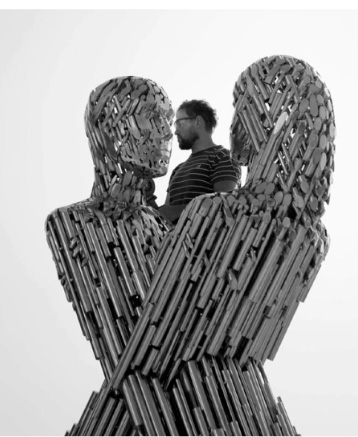
The artist creates chamber and monumental bronze compositions, and also experiments with new materials: papier-mâché, cardboard, mosaic, which expands the expressive possibilities of her plastic art. She pays special attention to the synthesis of sculpture with architectural and urban space.
Exhibition activities
Participant of numerous group and solo exhibitions, including:
- "Golden Line" (Kyiv, 1987).
- Biennale "Renaissance-91" (Lviv, 1991).
- Triennial of Sculpture of the Union of Artists of Ukraine (1999, 2005, 2008, 2011, 2014, 2020).
- Solo exhibitions in the galleries "Mykola's House", "Triptych", "Irena" (2004–2018).
Her works have been repeatedly exhibited at international art fairs in Zurich and Spain. Some of them are kept in private collections in Ukraine, Switzerland, the Czech Republic, Austria, the USA, Mexico and Germany.
Art style and themes
Svitlana Karunska is one of those artists who can do everything on her own. She is convinced that only someone who masters all stages of the craft can afford freedom in creativity.
"My father said: be able to do everything so that there is a chance to refuse it," says the artist.
Her self-discipline is combined with attentiveness to the world. She learns from people and situations, constantly observing how life suggests form. For her, creativity is a continuous dialogue between work and thought.
“The robots educate me, and I educate them,” Svitlana notes.
An important feature of the author's position is categoricality. Karunska rejects works that lack inner strength. Such self-demandingness becomes the principle of her artistic ethics.
In her sculptures, there is a desire for purity and clarity of form, for its constructive understanding. The artist consciously simplifies plasticity: in this structural concentration, a special inner energy of the image is born. Natural sincerity is just one of the many manifestations of the character of Svetlana's sculptural images. Her characters are sensitive, full of tenderness and a certain irony.
Her work reflects the intonations of the European plastic tradition, in particular the Italian masters of the 20th century. She is close to the laconicism of Arturo Martini, the simplicity of form and the inner irony of Marcello Mascherini. These features do not turn into imitation, but rather organically transform into a component of her personal aesthetics.
For Karunska, sculpture is poetry in solid material, a metaphor expressed through form. She believes that every detail, every stroke carries the energy of the artist. It is this energy that determines the value of the work.